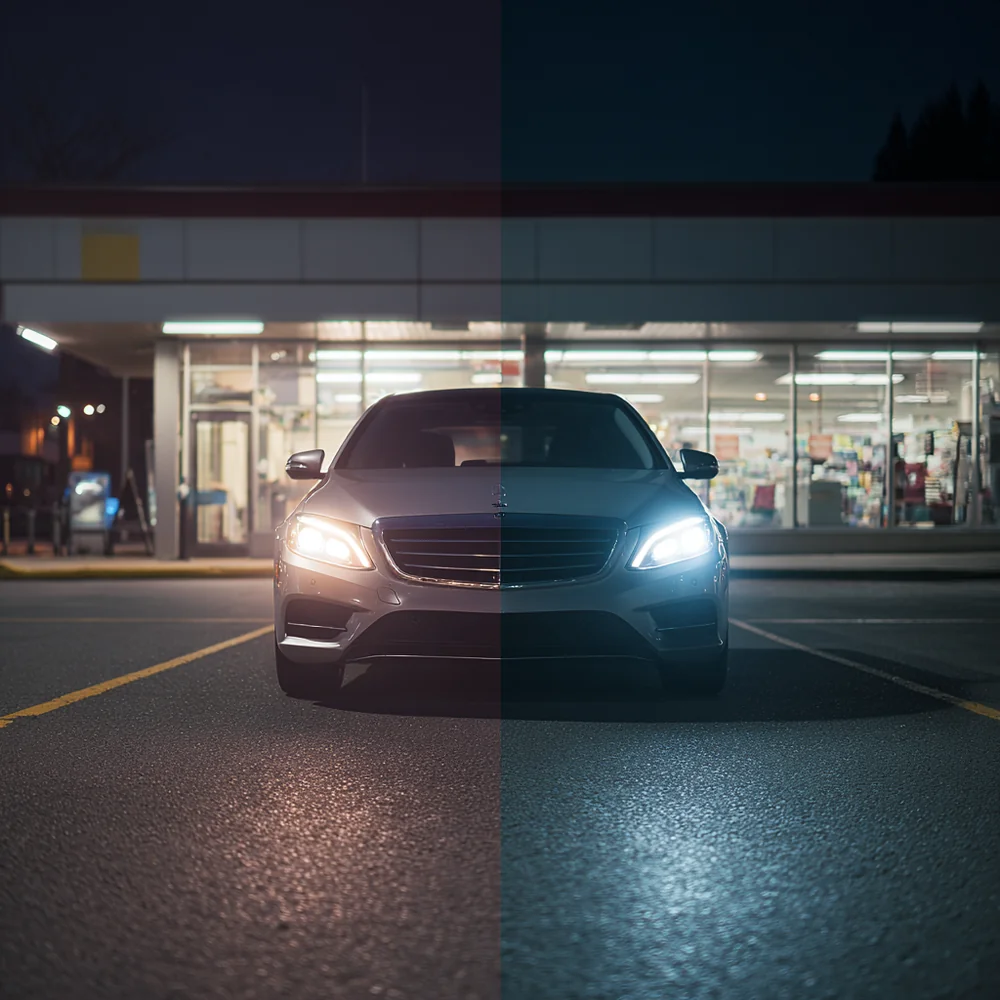
Parking lots and commercial yards do not just need “night vision” anymore. They need cameras that capture faces, plates, and vehicle colors in real darkness without turning the site into a floodlit stadium. This guide breaks down the best low light CCTV sensor choices for parking lots, how to compare low light performance across brands, and what to deploy in different types of outdoor areas.
If you are a B2B buyer or distributor, you will get practical, brand-agnostic rules you can reuse in quotes and proposals, plus examples of which vendors shine in each scenario. Let us start with the core question: what actually makes a low light CCTV camera good enough to stop theft after dark?
Q1. What really matters for the best low light CCTV sensors in parking lots?

The best low light CCTV cameras for parking lots combine three things: a good sensor, a fast lens, and smart illumination. The sensor size and design control how much real light gets captured, the lens aperture decides how much of that light reaches the sensor, and IR or hybrid lighting fills in the gaps when ambient light is weak or uneven.
If any one of those three is poor, you end up with grainy video, motion blur, or blown-out headlights that hide plates and faces.
Core low light ingredients
Sensor size & tech
Look for at least 1/2.8" or larger, with backside-illuminated CMOS in the spec sheet. Bigger, modern sensors need less digital gain and produce cleaner, more detailed images in low lux conditions.Lens aperture (F-number)
F1.0 to F1.4 lenses are a major upgrade over F2.0 and slower. Going from F2.0 to F1.0 can roughly quadruple the light reaching the sensor, which often helps more than just cranking resolution.WDR (wide dynamic range)
Essential in parking lots where you have headlights, streetlights, entry canopies, and dark corners in the same scene. Strong WDR reduces blown-out hotspots and keeps people and vehicles visible.AI-driven low light processing
Newer cameras use AI noise reduction, motion-aware exposure, and intelligent sharpening to keep moving targets clear at night instead of turning them into blurry ghosts.Illumination strategy
- IR for long range and discretion
- Hybrid IR + white light for color evidence and deterrence
- 850 nm IR for range vs 940/950 nm for no-glow and neighbor-friendly installs
Q2. Has low light CCTV really improved from 2024 to 2026, or is it just marketing?
Yes, it has improved, and not just in the brochure. The shift from “black-and-white blobs at night” to “usable color evidence in near darkness” is driven by better sensors, faster lenses, and AI-driven processing. Modern low light CCTV cameras in 2024–2026 handle motion, headlights, and mixed lighting far better than older “starlight” generations.
The marketing did change too. Instead of shouting “0.0005 lux,” leading brands now talk about sensor generation, F1.0 lenses, and hybrid smart illumination that only uses white light when needed.
Key low light trends you should actually care about
Full-color night imaging is now mainstream
Color-focused lines like Hikvision ColorVu, Dahua WizColor, Uniview ColorHunter, and Hanwha extraLUX are designed to keep color at night as long as there is at least minimal ambient or white-light assist.AI noise reduction is now a feature, not a buzzword
Motion-aware noise reduction helps keep moving people and vehicles sharp instead of smeared. This is critical for incident review, not just pretty demo images.Lighting reality is finally being respected
Vendors now design cameras specifically for high-contrast environments like parking areas with headlights and shopfronts, instead of pretending every scene is evenly lit.IR wavelength is a deliberate choice
850 nm remains standard for performance, while 940/950 nm “no-glow” is increasingly used near residences or in discreet commercial surveillance.
Q3. How should I compare low light CCTV cameras for outdoor parking areas beyond “lux” numbers?
Treat quoted lux numbers as polite fiction. For real low light CCTV comparison in outdoor parking areas, weigh sensor size, F-number, WDR, and illumination type against the specific scene.
Here is a quick comparison checklist you can actually use in sales conversations or internal evaluations.
Practical comparison checklist
Sensor & lens combo
- At least 1/2.8" sensor, ideally 1/2" or 1/1.8" for dark perimeters
- F1.0–F1.4 lens for general parking lots and yards
WDR & exposure
- Look for strong WDR and “forensic” or “true” WDR claims
- Check if there are anti-blur or motion-optimized modes for night
Illumination pattern & range
- Range that matches site dimensions, not just the headline max
- Uniform IR spread to avoid bright hotspots and dark patches
- Hybrid IR / white light for areas where color evidence matters
AI & analytics at night
- Verify that human/vehicle detection works in low light or IR
- Ask for real night sample clips, not only daytime marketing shots
Table 1: Low light features that matter more than lux numbers
| Factor | Why it matters in parking lots | What to aim for |
|---|---|---|
| Sensor size & type | Bigger, BSI sensors capture more usable light | 1/2.8" or larger BSI CMOS |
| Lens aperture (F-number) | Controls how much light reaches the sensor | F1.0–F1.4 for night-oriented cameras |
| WDR performance | Manages headlights, signage, and bright entrances | “Forensic” or 120 dB and above |
| IR / hybrid illumination | Fills dark zones, controls light pollution | IR + smart white light on events |
| AI noise & motion handling | Reduces smear and ghosting on moving targets | Brand’s latest AI / deep-learning engine |
Q4. Which brands currently lead for low light CCTV in parking lots & commercial yards?
Several brands have specialized low light families designed for parking and yard environments. As a distributor or B2B buyer, you do not have to memorize every product code, but knowing the “flagship” low light lines helps you steer customers correctly.
Snapshot of leading low light product families
1. Hikvision
ColorVu 3.0 Pro Series
Full-color imaging in ultra-low light using high-sensitivity sensors, large aperture lenses, and AI-enhanced color correction. Very strong fit for open parking lots where color evidence is important.Smart Hybrid Light Cameras (ColorVu-enabled)
Default IR with white light only on events. Great for sites near residential zones that want deterrence and neighbor-friendly lighting.Turbo HD ColorVu Series
For coaxial retrofits that need ColorVu-style performance without a full IP replacement.
2. Dahua
Smart Dual Light Series
IR as default, warm white light on detection, then back to IR. Strong for retail and office parking near homes that need color evidence but lower light pollution.WizColor Series
Heavy emphasis on F1.0 lenses and large pixel sensors for very low-light scenes where brightness and color clarity are the priority.
3. Uniview (UNV)
ColorHunter / ColorHunter 2.0
Full-color night imaging with smart dual light and built-in AI intrusion detection. Good fit for general parking areas that need color plus analytics.LightHunter (often PTZ / Prime Series)
Aimed at ultra-low-light wide areas, especially logistics yards and large parking lots.
4. Axis
AXIS P32 Series Domes
Lightfinder 2.0, Forensic WDR, and OptimizedIR. Designed for balanced, evidence-grade night imaging rather than flashy brightness.AXIS Q35 Series Domes
Built for harsh outdoor environments, with domes engineered to limit rain and snow reflection, excellent for premium commercial facilities.
5. Hanwha Vision (Wisenet)
- Wisenet X Series & extraLUX variants
Fast lens and sensor combos optimized for true-color low light and consistent image quality. Great for sites that want controlled illumination and stable performance across seasons.
6. Bosch / Keenfinity
- FLEXIDOME IP starlight 8000i / 5000i IR, DINION starlight 6000i, AUTODOME starlight 7000i PTZ
Focus on starlight sensitivity, strong HDR, and solid construction. Ideal for large commercial perimeters and PTZ-based monitoring.
7. Avigilon (Motorola Solutions)
- Unity H6A / H6X bullets and domes
IR-first designs with clearly documented IR ranges and minimum illumination specs. Well suited for very dark parking lots and yards that prefer reliable monochrome coverage and clear documentation.
Q5. When should I pick full-color night cameras versus IR-first cameras?
Both can be “best” depending on the site. Full-color night cameras shine where color details matter (vehicle color, clothing, branding) and where some ambient or controllable lighting is available. IR-first cameras win in very dark, long-range, or sensitive locations where you want surveillance but not lots of visible lighting.
Full-color night cameras are best when:
- You need vehicle color, clothing, and facial detail for evidentiary purposes.
- The area has moderate ambient light from streetlights, signs, or building lights.
- You want active deterrence, using white light and potentially audio as a visible warning.
IR-first cameras are best when:
- You cover very dark perimeters or deep yard rows with little or no ambient light.
- You need discreet surveillance without obvious white light.
- You want long-range coverage with minimal light pollution for neighbors or drivers.
Table 2: Full-color vs IR-first low light choices
| Scenario | Full-color night cameras | IR-first cameras |
|---|---|---|
| Standard commercial parking lot | Excellent fit, especially hybrid light | Good as supplement for darker zones |
| Dark perimeter / large back-of-yard | Usually needs extra lighting to work well | Ideal for long-range and cost-effective |
| Residential-adjacent sites | Use hybrid, event-only white light | Use 940/950 nm IR if discretion is key |
| Entrances & gates with headlights | Pair with strong WDR & controlled lighting | Use LPR-focused IR + fixed exposure |
Q6. How do I choose low light CCTV for three common commercial scenarios?

To keep it practical, let us break it into three typical B2B use cases: standard parking lots, dark yard edges, and entrances or key choke points.
Scenario A: Standard commercial parking lot
Think of grocery stores, business parks, office parking, and multi-tenant retail.
Best low light strategy
Hybrid illumination
IR normally, with white light activating only on motion events. You get color evidence for incidents without keeping the lot blindingly bright all night.WDR + AI processing
Strong WDR for headlights and storefront lighting, plus AI-driven noise reduction to reduce blur when cars pull in or people walk across camera views.Sensor & lens
1/2.8" or better sensor with F1.0–F1.4 lens. This combo usually offers enough brightness without excessive gain.
Example products to lean toward
Hikvision ColorVu Smart Hybrid, Dahua Smart Dual Light, Uniview ColorHunter, Hanwha extraLUX, Axis P32 with OptimizedIR for higher-end clients.
Scenario B: Dark perimeter rows and commercial yards
This is your “worst case” environment: low or no lighting, long distances, pallets, containers, or fleet vehicles.
Best low light strategy
Bigger sensor + fast lens
1/2" or 1/1.8" sensors with F1.0–F1.4 lenses give more usable light capture in near darkness.Long-range, uniform IR
Look beyond the headline “IR up to 100 m” and check beam spread. Uneven IR leads to bright license plates and pitch-black backgrounds.Optional thermal pairing
For very large logistics yards or perimeters, pairing visible low light PTZ cameras with thermal units helps detect intrusions regardless of lighting.
Example products to lean toward
Uniview LightHunter PTZ, Bosch AUTODOME starlight, Axis Q PTZ with OptimizedIR, Avigilon Unity H6X IR bullets.
Scenario C: Entrances, exits & license plate capture
Choke points are where you can actually identify who came and went. Low light LPR or ANPR setups live or die on exposure control, not just “good night vision.”
Best low light strategy
Dedicated LPR / ANPR cameras
Use cameras designed for license plate capture, with fixed shutter speeds that freeze motion.Synchronized IR
Dedicated IR aimed at the plate, synchronized with camera settings, avoids plate glare or unreadable blur.Correct mounting geometry
The camera angle, height, and offset from the lane matter just as much as the sensor. Keep plate angle within the vendor’s recommended degrees.
Q7. How should distributors talk about low light CCTV without boring customers to sleep?
Instead of drowning customers in lux values, translate the tech into business outcomes: ID distance, plate success, neighbor complaints, and incident clarity. Low light CCTV marketing that mentions “AI-powered night vision” should highlight motion clarity, not just brightness.
B2B-ready messaging tips
Replace “always-on white light” with
“Smart hybrid illumination that uses IR by default and switches to white light only when people or vehicles are detected.”Explain AI features as
“AI-powered night vision that keeps moving targets clear and reduces nighttime blur, so you get usable evidence, not just bright noise.”Move from specs to results
- “Plates readable at 15–20 meters at night in this entrance lane.”
- “Faces recognizable in the main parking rows even with headlights in frame.”
- “Perimeter covered end-to-end with IR, without adding visible lighting.”
Q8. What is the fastest way to shortlist the best low light CCTV sensors for a new site?
Use a simple three-step filter:
Map the light, not just the layout
Identify areas that have decent ambient light (storefronts, main rows) versus dark zones (perimeter, rear yard).Match sensor & illumination to each zone
- Full-color hybrid cameras in moderately lit areas and entries
- IR-first, larger-sensor cameras on dark perimeters and deep yard rows
Ask vendors for real night clips, not just datasheets
Compare how moving cars and people look at night in sample footage, especially in scenes that resemble your site.
If you follow that process, “best low light CCTV sensors” stops being a buzz phrase and turns into a clear, justifiable selection for each part of the parking lot or yard.
Q9. Quick FAQ: Short, straight answers for busy buyers
Q: Is a 4K camera always better at night than a 2 MP camera?
Not necessarily. A 4K camera with a small sensor and slow lens can look worse at night than a 2 MP camera with a bigger sensor and F1.0 lens. For low light, sensor quality and F-number often matter more than resolution alone.

Q: Should I keep white lights on all night for security cameras?
Only if you have a specific deterrence goal and no neighbor issues. For most commercial parking lots, hybrid IR + event-based white light balances evidence quality with comfort and energy use.
Q: Does “0.000x lux” actually mean anything?
By itself, not much. Without knowing testing conditions, shutter speed, and noise reduction, lux numbers are marketing. Use them as a rough hint, not a decision driver.
Q: 850 nm or 940 nm IR for commercial yards?
Use 850 nm IR for longer range and better overall performance. Use 940/950 nm IR if you are next to residences or want very discreet, no-glow installations and can accept reduced range.
Q: What single spec should I check first for low light CCTV?
Check the sensor size and F-number together. If they look good, then check WDR and illumination. If they are weak, it is probably not your best low light choice, regardless of the lux claim.
With these guidelines, you can confidently compare low light CCTV sensors, pitch the right solutions for outdoor parking areas and commercial yards, and actually reduce theft after dark instead of just recording shadows.
Do lux ratings predict real low-light parking lot performance?
No, lux ratings alone do not predict real performance. Vendors test lux under different shutter speeds and noise reduction, so numbers rarely match your site. Compare sensor size, F-number (F1.0–F1.4), WDR for headlights, and the real IR or hybrid illumination pattern using night sample clips.
What sensor and aperture specs matter most at night?
Sensor size plus lens aperture matters most at night. Aim for at least a 1/2.8" sensor, ideally 1/2" or 1/1.8", and a fast F1.0–F1.4 lens to capture more usable light. Then validate strong WDR and motion-friendly exposure to limit blur.
How do WDR and smart IR improve night evidence quality?
WDR keeps headlights, canopies, and dark corners visible in the same frame, which protects faces and vehicle details from blowout. Smart IR or hybrid lighting fills dark zones with a more even beam and can switch from IR to white light on events, improving color evidence without constant glare.